The quality of a brazed joint does not depend exclusively on the alloy used or the process parameters. An equally important factor, and often decisive for the success of the brazing operation, is the use of fluxes, commonly referred to as brazing fluxes.
Their main function is to ensure that the brazing alloy can properly wet the surfaces to be joined, promoting the formation of a strong, uniform and reliable joint.
In this article, we analyze the role of fluxes, their main functions and the criteria to consider when selecting the most suitable product.
Why Oxides Form During Brazing
When a metal is heated in the presence of air, its surface tends to react with oxygen, forming a layer of oxides.
These oxides represent one of the main obstacles to successful brazing because they prevent the molten alloy from adhering to and spreading evenly across the surfaces.
The presence of oxides can lead to:
- poor wetting of the brazing alloy;
- incomplete joint filling;
- porosity;
- reduced mechanical strength;
- leakage defects.
For this reason, oxidation control is a fundamental aspect of the brazing process.
What Is the Function of Fluxes?
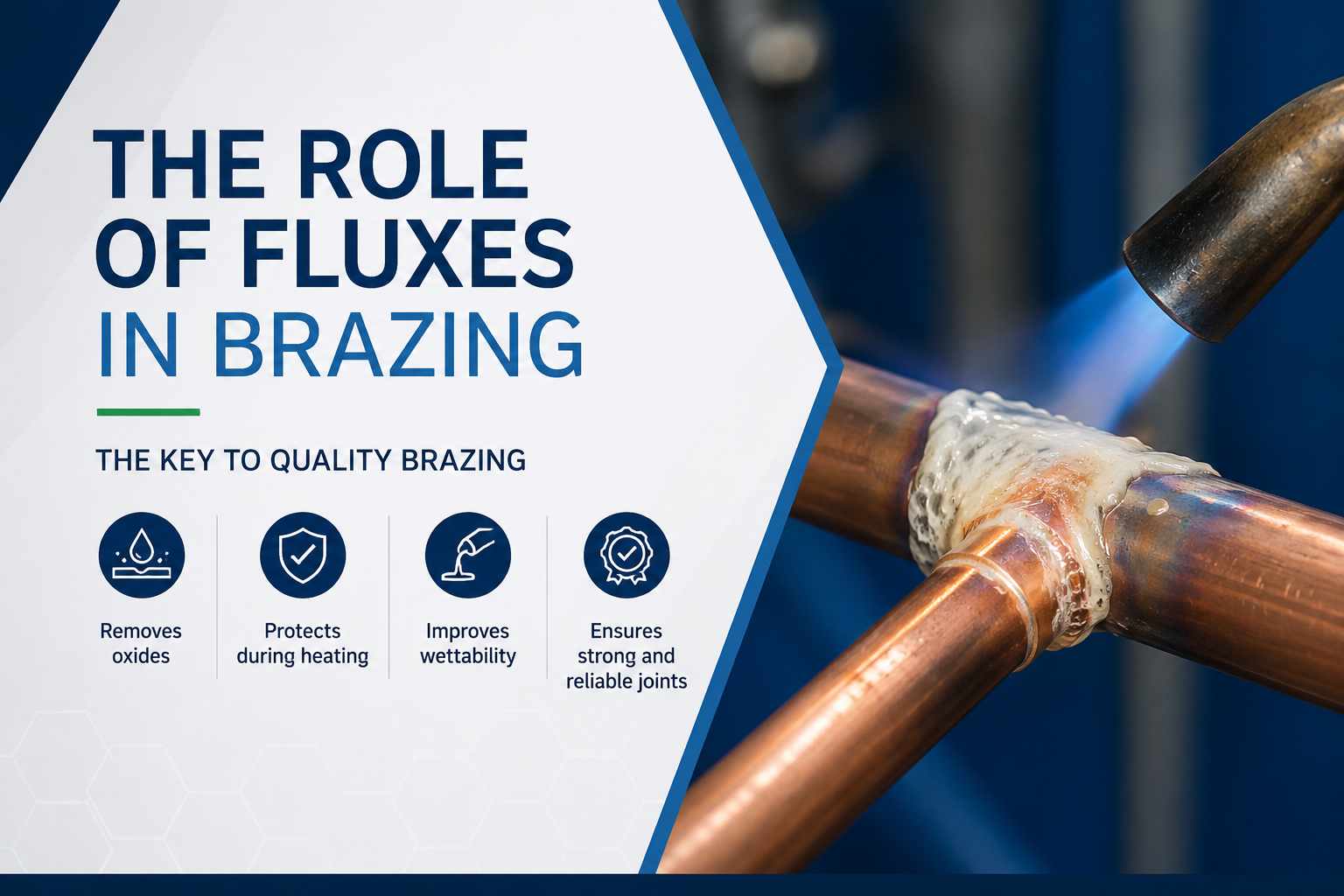
Brazing fluxes perform several functions simultaneously.
Removal of Surface Oxides
The primary function is to dissolve or remove oxides already present on metal surfaces before the alloy begins to melt.
This allows the brazing alloy to come into direct contact with the base material.
Protection During Heating
During the heating cycle, the flux creates a protective barrier that limits contact between the hot metal and the surrounding atmosphere.
This reduces the formation of new oxides.
Improved Wettability
A clean surface allows the molten alloy to properly distribute itself within the joint through capillary action.
This is essential for obtaining uniform, defect-free joints.
When Is a Flux Required?
The need to use a flux mainly depends on the materials involved and the brazing alloy being used.
Generally, a flux is required for:
- silver-based alloys;
- brazing of carbon steels;
- brazing of stainless steels;
- brass and other copper alloys;
- applications carried out in air atmosphere.
There are, however, some exceptions.
Copper-phosphorus (CuP) alloys, for example, are considered self-fluxing in copper-to-copper applications, thanks to the phosphorus content that performs a deoxidizing function during the process.
In these cases, the use of flux may not be necessary.
How to Select the Right Flux
The selection of the appropriate flux should take several factors into account.
Compatibility with the Brazing Alloy
Each flux is designed to operate within specific temperature ranges.
Therefore, it is essential that the activation temperature of the flux is compatible with that of the alloy being used. A flux is considered effective when its working temperature is at least 50°C lower than the melting temperature of the brazing alloy.
A flux that activates too early or too late may fail to provide effective protection.
Compatibility with Base Materials
Different materials generate different types of oxides.
Stainless steels, copper, brass and specialty alloys may require specific formulations to ensure effective surface cleaning.
Application Method
Fluxes are available in different forms:
- powder;
- paste;
- liquid;
- coating directly applied to the brazing alloy.
The choice depends on the production process and the required level of automation.
Main Issues Related to Fluxes
Even a properly selected flux can cause problems if used incorrectly.
Insufficient Quantity
Too little flux may not provide complete protection of the surfaces.
The result may be poor wettability and the formation of joint defects.
Excessive Quantity
Excessive use of flux may leave residues after brazing and increase cleaning operations.
Overheating
Excessively high temperatures can degrade the flux before the alloy begins to perform correctly.
In these cases, oxidation protection is lost and joint quality may be compromised.
Post-Brazing Residues
Some residues may become corrosive over time if they are not properly removed.
For this reason, it is important to follow the manufacturer’s recommendations regarding final cleaning of the component.
The Importance of Fluxes in Industrial Processes
In modern industrial production, process repeatability is a fundamental requirement
The correct combination of:
- brazing alloy;
- flux;
- temperature;
- joint geometry;
makes it possible to achieve consistent results and significantly reduce production scrap.
makes it possible to achieve consistent results and significantly reduce production scrap. For this reason, flux should not be considered merely an auxiliary material, but rather an essential component of the brazing system.
Conclusion
Brazing fluxes play a fundamental role in ensuring the quality and reliability of brazed joints.
Their ability to remove oxides, protect surfaces during heating and improve alloy wettability enables more uniform and repeatable results.
The selection of the correct product must take into account the brazing alloy, the materials being joined and the process conditions.
A properly selected and applied flux is one of the key factors for the success of any brazing operation.
Pietro Galliani’s Range of Brazing Fluxes
Selecting the correct flux is just as important as selecting the brazing alloy itself. For this reason, in addition to a wide range of brazing alloys, Pietro Galliani S.p.A. offers a complete line of fluxes developed to meet the requirements of the main industrial brazing processes, ensuring effective oxide removal and excellent surface protection during the brazing cycle.
The range includes products specifically designed for:
- silver-based alloys;
- copper-phosphorus and copper-phosphorus-silver alloys;
- brazing of steels and stainless steels;
- HVAC and refrigeration applications;
- manual and automated processes.
GALFLO Eco Green: The New Generation of Fluxes
Among the most innovative solutions developed by Pietro Galliani Brazing is GALFLO Eco Green, a flux designed to meet the latest manufacturing industry requirements in terms of safety, sustainability and performance.
GALFLO Eco Green has been developed to provide:
- high effectiveness in oxide removal;
- excellent wettability of brazing alloys;
- ease of application;
- reduced impact on operators and the environment compared to traditional fluxes containing substances classified as more critical.
Thanks to these characteristics, it represents a particularly attractive solution for companies looking to improve the sustainability of their processes without compromising brazing quality.
For more information about the technical characteristics and applications of GALFLO Eco Green, please visit the dedicated section of our website or contact our technical team.