Choosing the Right Technology for Reliable Joints and Efficient Manufacturing Processes
Brazing is one of the most reliable and versatile joining processes used in modern manufacturing. However, the final result depends not only on selecting the right brazing alloy or flux, but also on choosing the most suitable heating technique.
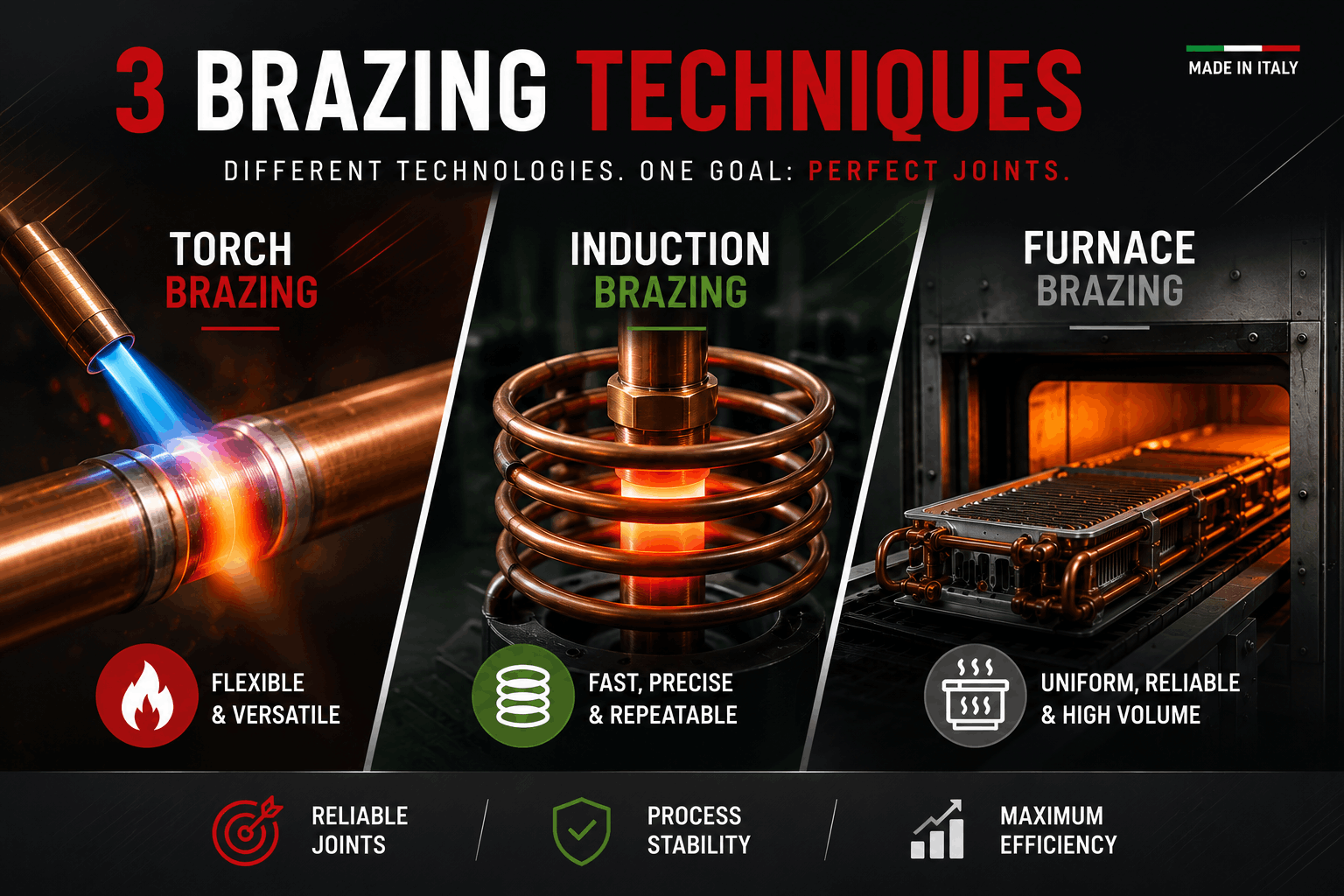
The three main brazing techniques used in industrial applications are
- Torch Brazing
- Induction Brazing
- Furnace Brazing
Each method offers specific characteristics, advantages and limitations, making it more or less suitable depending on the base materials, production volume, required precision and level of automation.
In this article, we examine how these three technologies work and provide practical guidance to help you select the most appropriate solution.
One Principle, Three Different Ways of Generating Heat
Regardless of the heating method used, the fundamental principle of brazing always remains the same.
The base materials are not melted.
Instead, the brazing alloy melts and flows into the joint by capillary action, creating a strong and permanent metallurgical bond.
What changes is simply the way heat is generated and transferred to the component.
Torch Brazing
Torch brazing is the most widely recognized and commonly used brazing technique.
Heat is generated by the combustion of a fuel gas (such as acetylene, propane or methane) combined with oxygen or air. The operator directs the flame onto the component until the required brazing temperature is reached.
Advantages
- High operational flexibility
- Low initial equipment investment
- Suitable for large components
- Ideal for maintenance, repair work and small production batches
Torch brazing is the preferred solution for HVAC installations and copper piping systems.
Limitations
- Joint quality strongly depends on operator skill
- Greater heat dispersion
- Possible distortion of thin components
- Lower repeatability in high-volume production
Induction Brazing
Induction brazing uses a high-frequency electromagnetic field to generate heat directly within the component.
An induction coil creates a magnetic field that induces electrical currents in the metal, producing highly localized heating.
This technology is becoming increasingly popular in automated manufacturing lines.
Advantages
- Very rapid heating
- High precision
- Excellent repeatability
- Reduced heat input to surrounding areas
- High energy efficiency
- Easy integration into automated production lines
Limitations
- Higher initial investment
- Dedicated induction coils required
- Less flexibility when production changes frequently
Furnace Brazing
Furnace brazing is the ideal solution for high-volume production and complex assemblies.
Components are placed inside a furnace where the entire thermal cycle is accurately controlled.
The process can be carried out:
- in a controlled atmosphere;
- in a protective atmosphere;
- under vacuum.
Advantages
- Uniform heating
- High-quality joints
- Excellent repeatability
- Multiple components brazed simultaneously
- Reduced oxidation
Limitations
- High equipment investment
- Generally longer production cycles
- Less flexibility for small production runs
How to Choose the Right Brazing Technique
There is no single brazing technique that is suitable for every application.
The best choice depends primarily on the following factors.
Production Volume
- Small production batches → Torch Brazing
- Medium to high production volumes → Induction Brazing or Furnace Brazing
Required Precision
When extremely accurate temperature control is required, Induction Brazing is often the preferred solution.
Component Size
Large components or on-site installations are generally brazed using a torch.
Small, repetitive components are better suited to automated brazing processes.
Base Materials
Some materials require very precise thermal control, making induction or furnace brazing the preferred technologies.
The Importance of Selecting the Right Brazing Alloy
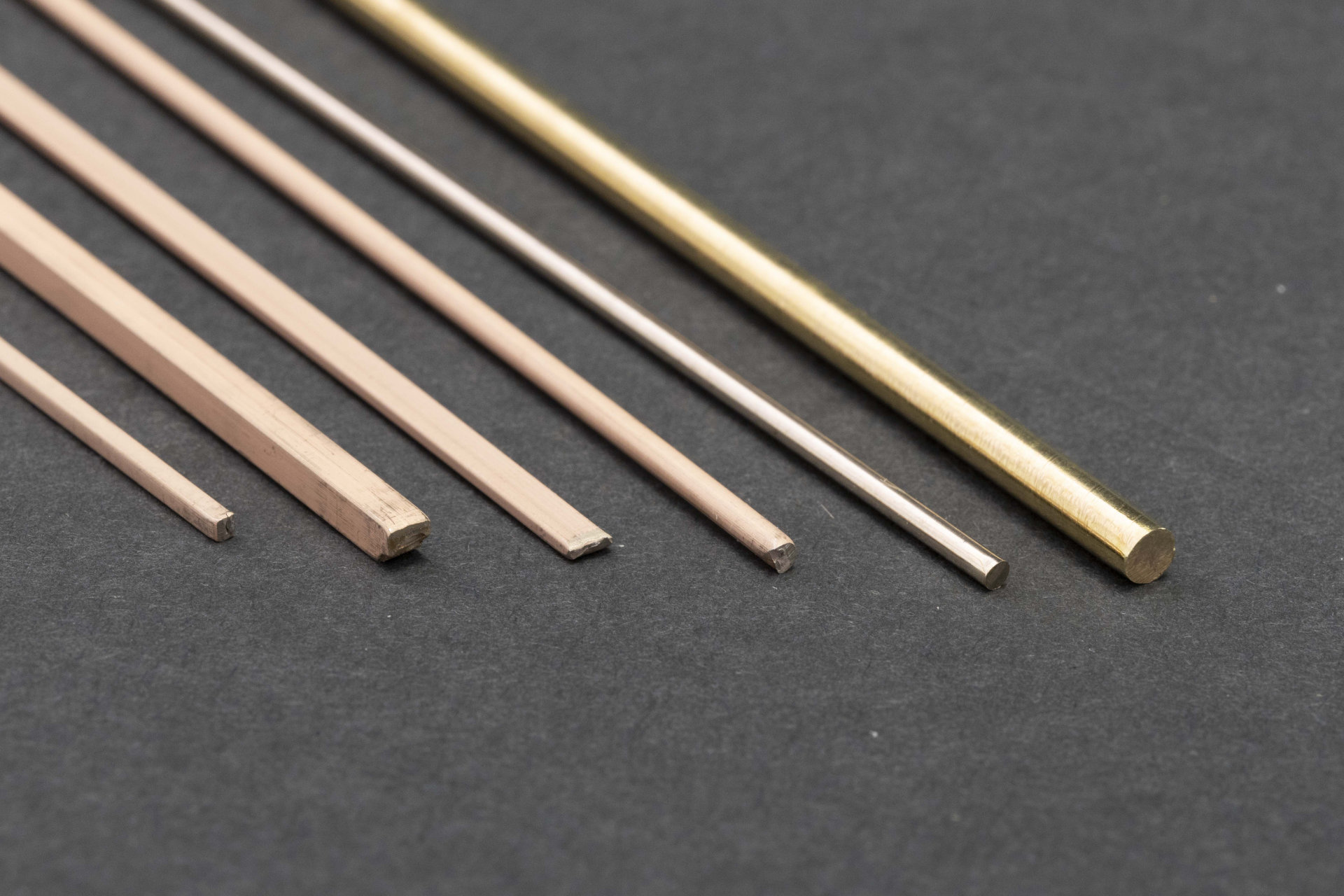
The heating technique should always be considered together with the selection of the appropriate brazing alloy.
Each alloy has its own:
- melting temperature;
- flow characteristics;
- recommended brazing temperature range.
Choosing the correct combination of brazing technique and alloy results in more reliable joints and improved production efficiency.
Flux Selection Is Equally Important
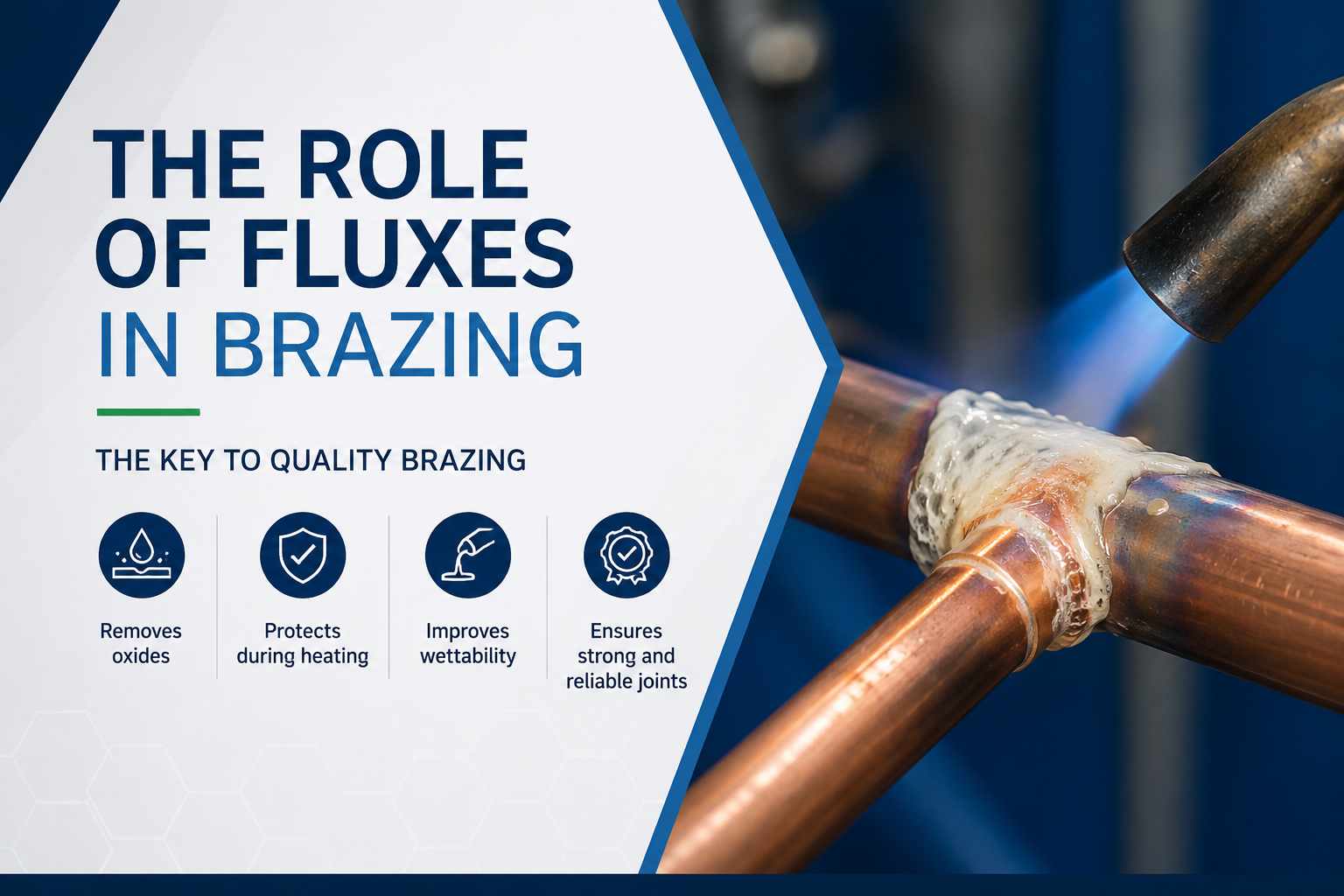
For brazing processes performed in air—such as torch brazing and many induction brazing applications—the selection of the appropriate brazing flux plays a fundamental role.
Flux protects the surfaces fro oxidation, improves alloy wettability and promotes the formation of sound, defect-free joints.
In furnace brazing processes carried out under controlled atmosphere or vacuum, however, the use of flux may be reduced or, depending on the process, may not be required at all.
| 🔥 Torch Brazing | ⚡ Induction Brazing | 🏭 Furnace Brazing |
|---|---|---|
| Best suited for | Best suited for | Best suited for |
| HVAC systems | Automated production | Mass production |
| Copper piping | Precision components | Heat exchangers |
| Maintenance | Automotive | Complex assemblies |
| Repair work | Electrical contacts | Controlled atmosphere processes |
| Advantages | Advantages | Advantages |
| ✓ Low investment | ✓ High precision | ✓ Uniform heating |
| ✓ High flexibility | ✓ Fast heating | ✓ Excellent repeatability |
| ✓ Easy to use | ✓ High energy efficiency | ✓ Multiple parts processed simultaneously |
| Limitations | Limitations | Limitations |
| Operator-dependent | Higher investment | Higher investment |
| Lower repeatability | Dedicated induction coils | Longer production cycles |
Choosing the right brazing technique improves quality, repeatability and manufacturing efficiency.
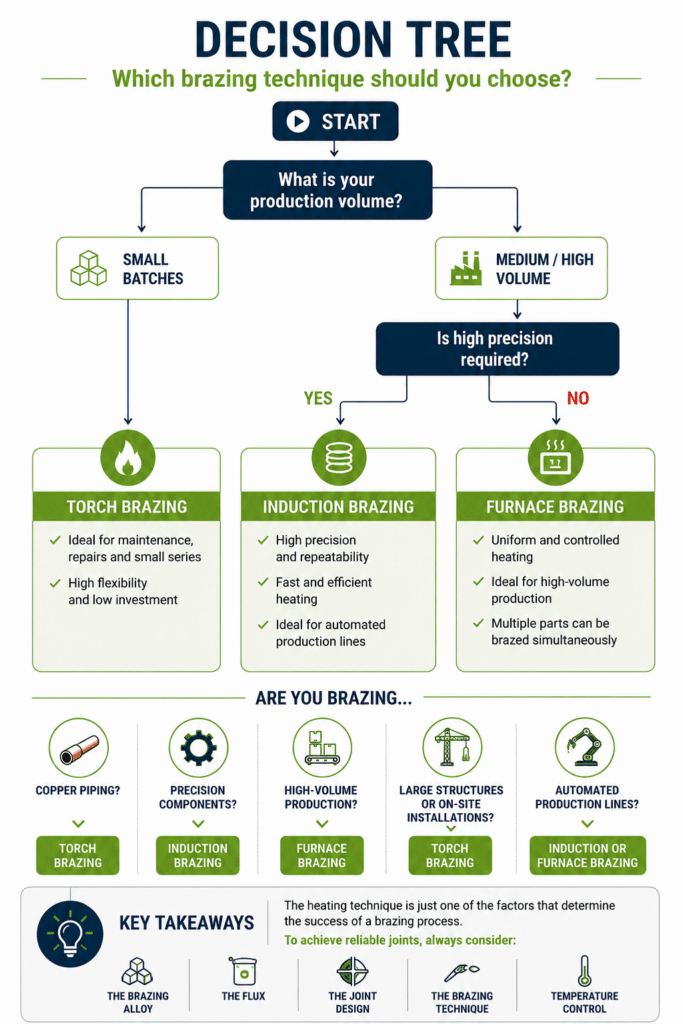
Are You Brazing…
🟠 Copper piping?
➡ Torch Brazing
⚙ Precision components?
➡ Induction Brazing
🏭 High-volume production?
➡ Furnace Brazing
🔥 Large structures or on-site installations?
➡ Torch Brazing
🤖 Automated production lines?
➡ Induction Brazing or Furnace Brazing
Key Takeaways
The heating technique is only one of the factors that determine the success of a brazing process.
To achieve reliable, high-quality joints, always consider:
✅ Brazing alloy
✅ Brazing flux
✅ Joint design
✅ Brazing technique
✅ Temperature control
Pietro Galliani Solutions
Regardless of the brazing technique selected, choosing the appropriate brazing alloy and flux is essential to achieve reliable and repeatable results.
Pietro Galliani offers a complete range of:
- Silver-based brazing alloys
- Copper-phosphorus (CuP) brazing alloys
- Copper-phosphorus-silver (CuPAg) brazing alloys
- Brazing fluxes
- GALFLO Eco Green environmentally responsible brazing fluxes
All of our products are developed to ensure outstanding joint quality, process stability and maximum reliability across a wide range of industrial applications.